Table Of Contents of my Passover Articles
- The Haftorah For Shabbos HaGadol, Serving G-d and Not Serving Yourself
- We’re Leaving Mitzrayim, Are You In?
- Why We Need The Symbols Of Slavery Also on the Table
- The Second Half Of Maggid Starting With “Metchila Ovday…”
- The Seder Night As the Vehicle of Passing Over the Tradition to the Children and Grandchildren
- A Collection of Individual Points on the Story of the Exodus
- More On The Passover Haggadah
- Seder Night and the Day After
- The Last Day of Pesach, What Was Revealed At the Splitting of the Sea
- Reciting Shiras Hayam Joyfully as if I Passed Through the Sea
You Shall Tell Your Son on Pesach
Searching for Jewish Beliefs? Click Here for my main article on Jewish Beliefs.
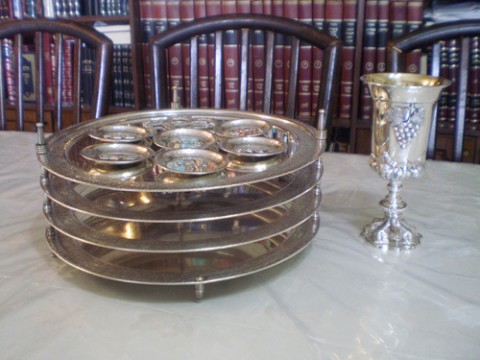
We come to the Seder night and find on the table symbols in both directions, both of the slavery and of the redemption, on the one hand Maror, and on the other hand, wine. Matzo really has both aspects, it is called Lechem Oni, poor man’s bread that we were forcefully fed in Egypt, yet on the other hand it is the sign of redemption in that when the time came, the deliverance went so fast that there wasn’t even time to make the basic foodstuff, bread.
The Seder Night: From Slavery to Freedom
I suggest that the reason that we have both of the symbols on the table is because the goal of the night is to feel the emancipation itself, the going out, the transition from slavery to freedom. Therefore we require both, the slavery and the freedom, and therefore the special place of the Matzo which characterizes both sides. Maybe this is the reason that we start the recitation of Maggid with Ha Lachma Anya.
Matza and Maror
With the above we can understand something that bothered me all of the years. In the discussion about when the Mitzvah of Sippur Yetzias Mitzraim may be performed (Yachol Me’Rosh Chodesh …), we say there that I might think that it may be performed while still day (Erev Pesach, the 14th), talmud lomar, “ba’avor ze …”, “because of this …”, an implication that there is something to point to. “Ba’avor ze” I only say when there is Matza and Maror sitting in front of you.
It always troubled me, it would seem that the “hava amina” that the Mitzva can be done by day is because then we are already occupied in the Mitzvos of the day, in the offering of the Korban Pesach. But if so, what does the Ba’al HaHagada see in the verse “Ba’avor Ze” to exclude this hava amina? It would seem reasonable that also the Korban Pesach is something that one can point to, so why not tell the story and relive the experience then, by day? What forces the Ba’al HaHagada to conclude that it is only by night?
What I think they say is that the Pesach sacrifice comes to completion only when we eat it, which is by night, so therefore it is indeed not reasonable to conclude that Sippur Yetzias Mitzraim can be done by day. I can hear this, but I find that this answer doesn’t really satisfy the innards like the Korban Pesach is supposed to.
But according to what I wrote above, the avoda of the night is to experience the actual redemption from Egypt, the going out, the transformation from slavery to freedom. This I can only do when there is Matza and Maror sitting in front of me, the symbols of slavery. It is not enough just a symbol of freedom, the Korban Pesach.
This is nicely worded in the verse, “Ba’avor Ze, because of this, Hashem did for me, BeTzaisi, in my going out from Egypt”.
Chag Kosher Ve’Somayach
Boruch Rappaport





Leave A Response